We're just finishing up the reading comprehension unit in Shane's English class (thank goodness: no more Iqbal!), and we're moving onto the creative writing units. On the grade 10 English literacy test that high school students are required to pass to graduate, there will be several questions that require the student to write paragraphs or essays. Many of these require the student to form an opinion and support it. There are few types of opinion paragraphs. These include: comparing and contrasting 2 things; "my favourite ..."; ethical opinions or an opinion on whether certain events or rules should be upheld.
There are some basic rules to follow for every opinion paragraph. A minimum of 5 sentences are required: the opinion statement, 3 supporting reasons, and a conclusion that either re-states the opinion or (even better) tells us what the next step is (ie what you will do about it or a recommendation). If you can finish up with a recommendation, the marks will really go up! Coincidentally, the opinion paragraph later graduates into an essay, with a similar structure, except that each sentences turns into a paragraph. More on developing this later.
The easiest opinions to start with are the "my favourite ..." ones. These will hold some relevance to your child and will make it easier to think of the supporting reasons. Note that "because I like it" is not a proper support. Challenge your child to give specific details.
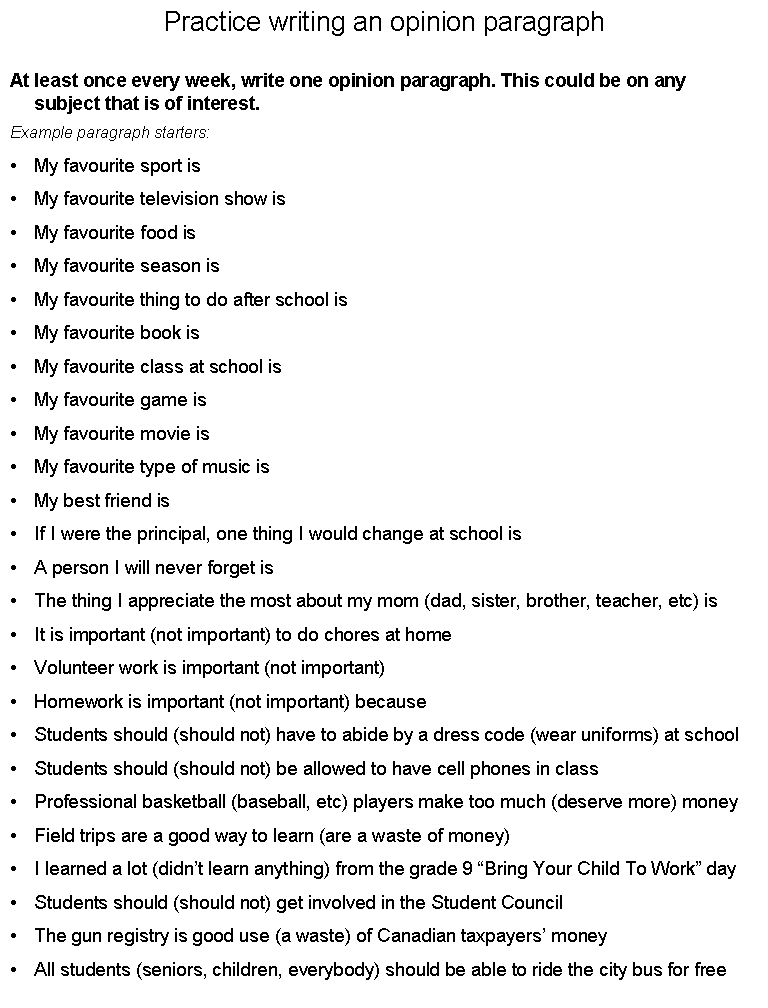
Here are some paragraph starters. Try to write at least one paragraph every week.
Tips and tutor coaching help for kids and teenagers with Aspergers Syndrome.
November 27, 2010
November 20, 2010
Report Cards - celebrating!
Normally I don't put a lot of stock in the mid-term report cards. I've seen some where Shane is in the mid-to-high seventies at mid-term and ends up failing the course because he couldn't do a poster, worth 30%, at the very end of the semester.
But this time around, Shane called me at work, to tell me all the marks he's getting so far. Well, he's above the class average in every course, except English, for which he is at 70% right on the average. This is the very best report card he has ever brought home. He's really really proud of these marks, thus prompting the phone call right away after school. So, we're going to Starbucks today to celebrate with a decaf almond latte - Shane's favourite. Holly is coming too. Of course, she is doing very well in school also, but she would have come with us no matter what. The deal with us is: we all get to celebrate successes, but failures are not punished - they are simply learning opportunities.
Look for things to celebrate yourselves - choosing appropriate clothes to wear, buttering his own toast, being on time for the bus, anything that you want to continue ... Everyone wants to be successful. Find something, point it out, celebrate it, and the chances are pretty good it will be repeated.
Cheers!
Lisa
But this time around, Shane called me at work, to tell me all the marks he's getting so far. Well, he's above the class average in every course, except English, for which he is at 70% right on the average. This is the very best report card he has ever brought home. He's really really proud of these marks, thus prompting the phone call right away after school. So, we're going to Starbucks today to celebrate with a decaf almond latte - Shane's favourite. Holly is coming too. Of course, she is doing very well in school also, but she would have come with us no matter what. The deal with us is: we all get to celebrate successes, but failures are not punished - they are simply learning opportunities.
Look for things to celebrate yourselves - choosing appropriate clothes to wear, buttering his own toast, being on time for the bus, anything that you want to continue ... Everyone wants to be successful. Find something, point it out, celebrate it, and the chances are pretty good it will be repeated.
Cheers!
Lisa
November 7, 2010
Free worksheets - Area and Perimeter
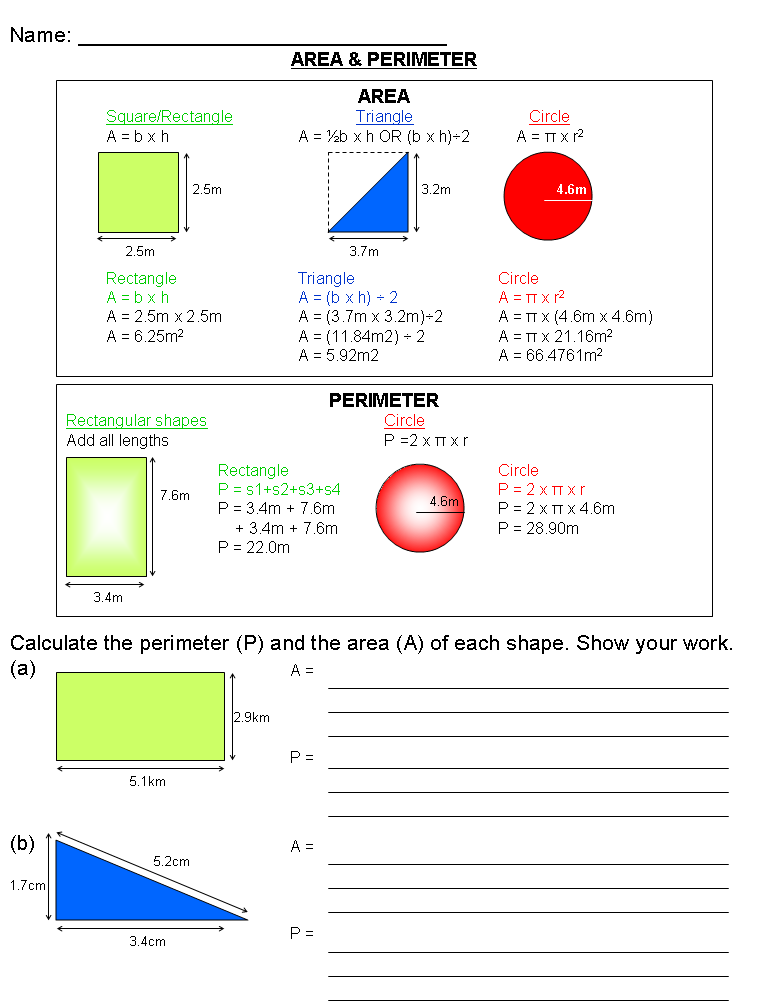
I read recently about making math fun. I have tried different ways to make things tangible for Shane and/or bring baseball into the discussion in some way. So, with my worksheets, I'm going to start with a warm-up at the beginning of each. It will either be an exercise, a craft, a riddle, or a word problem that's a little fun and gets Shane moving or starts him off interested in the subject.
This one, for calculating area and perimeter of 2D shapes, has a joke and a simple exercise that hopefully is challenging but gets him thinking about area in a tangible way. There will be a second area/perimeter worksheet, where he will be calculating how much paint is needed to paint a wall, or how many tiles are needed for a roof - this brings it into real life.
So here are the first Area/Perimeter worksheets.
This one, for calculating area and perimeter of 2D shapes, has a joke and a simple exercise that hopefully is challenging but gets him thinking about area in a tangible way. There will be a second area/perimeter worksheet, where he will be calculating how much paint is needed to paint a wall, or how many tiles are needed for a roof - this brings it into real life.
So here are the first Area/Perimeter worksheets.
October 31, 2010
Free worksheets - math - BEDMAS
Shane doesn't have math this semester at school, but I don't want him to lose it completely (which is usually the case). So, I thought a little refresher on BEDMAS would be good. He tends to forget the order, and prefers simply to read and compute from left to right.
There are a couple of youtube videos that explain the order as well, just type in a search for BEDMAS math, and you should be able to find them.
BEDMAS stands for Brackets, Exponents, Divide, Multiply, Add, and Subtract. Essentially, the acronym describes the order that the components of an equation should be calculated first. Each calculation type is an "operation", so for example, multiplying is an operation. Each 2 letters go together, so brackets and exponents are first. Multiply and Divide are next. Add and Subtract are last. Within each 2-letter set, calculate in the order you read it, from left to right.
I have not found another way of coaching on this, other than the BEDMAS acronym and following the rules plus rote practice.
So, here are 2 worksheets along with the answer keys.
There are a couple of youtube videos that explain the order as well, just type in a search for BEDMAS math, and you should be able to find them.
BEDMAS stands for Brackets, Exponents, Divide, Multiply, Add, and Subtract. Essentially, the acronym describes the order that the components of an equation should be calculated first. Each calculation type is an "operation", so for example, multiplying is an operation. Each 2 letters go together, so brackets and exponents are first. Multiply and Divide are next. Add and Subtract are last. Within each 2-letter set, calculate in the order you read it, from left to right.
I have not found another way of coaching on this, other than the BEDMAS acronym and following the rules plus rote practice.
So, here are 2 worksheets along with the answer keys.
October 24, 2010
Iqbal chapter 3 - opinion paragragh
We changed it up a little for chapter 3 of the Iqbal novel. Instead of concentrating only on comprehension, I wanted to use chapter 3 to help with an opinion paragraph. Each of the learning styles will encounter the same types of essay or opion paragraph questions, but their approaches might be different.
Before writing, some kind of pro's / con's exercise is often helpful. I have it organized in a table, but visual learners may feel more comfortable with a "mind map" (just letting their thoughts flow in a web or along a path or like a map.
When writing an opinion paragraph, it should have at least 5 sentences:
Here's the question and a sample answer. The book deals with child slaves in Pakistan, and the children in chapter 3 are discussing masters and their opinions. Your child can draw from the discussion in the book to help them form their own opinion.
Before writing, some kind of pro's / con's exercise is often helpful. I have it organized in a table, but visual learners may feel more comfortable with a "mind map" (just letting their thoughts flow in a web or along a path or like a map.
When writing an opinion paragraph, it should have at least 5 sentences:
- Introduction sentence that states your opinion.
- First support sentence that gives the first (either the least or the most important) reason.
- Second support sentence that gives another reason.
- Third support sentence that gives the last (either the most or the least important) reason.
- Final conclusion sentence that wraps up your opinion. This can start "These are the reasons why I think...".
Here's the question and a sample answer. The book deals with child slaves in Pakistan, and the children in chapter 3 are discussing masters and their opinions. Your child can draw from the discussion in the book to help them form their own opinion.
October 17, 2010
Iqbal Reading Comprehension chapter 2
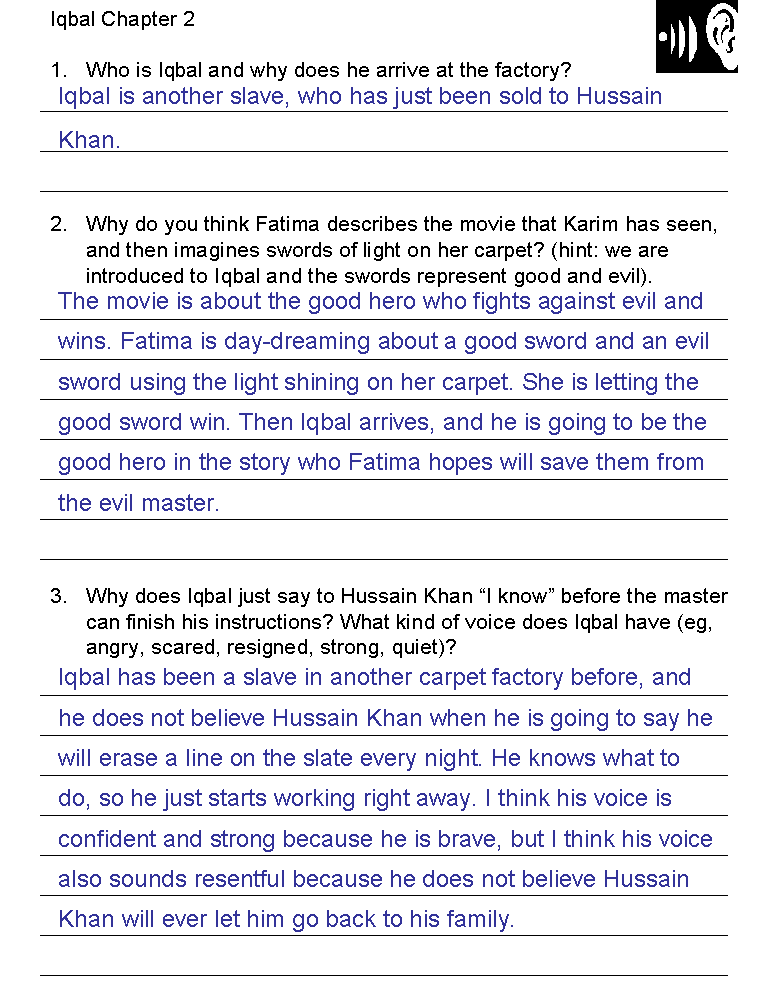
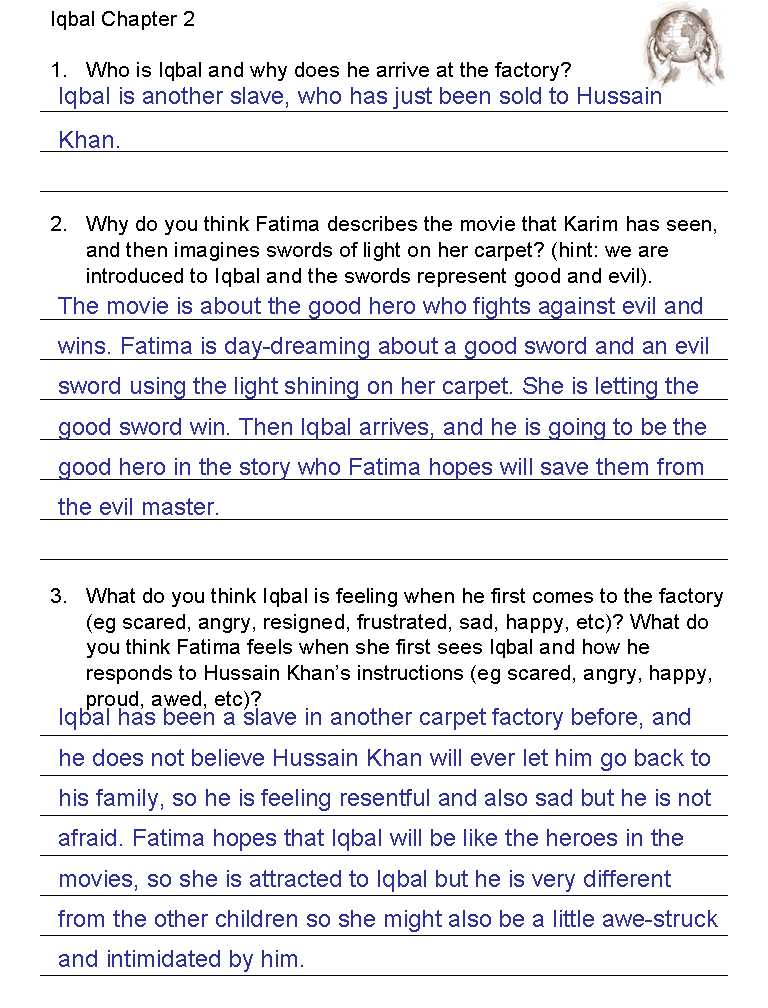
Here are the worksheets, by learning style, for the Iqbal novel chapter 2. I've also posted answers to each, but note that these are really examples. Encourage your child to use his imagination, and form opinions.
Auditory
Auditory
Kinesthetic
October 9, 2010
Reading Iqbal - grade 10 English worksheets
Shane is reading the novel, Iqbal, for English, and I've made up some worksheets. The book is "Iqbal" by Francesco D'Adamo. It is based on a true story of a child slave in Pakistan, and (spoiler alert) it is not light reading. The entire story is meant to be thought-provoking, with several opportunities to form opinions. As we get deeper into the book, I will be using it to practice opinion essays (5 paragraphs, that follow a structure - more on this in a few weeks).
Recently, I've been trying hard to cater more to Shane's individual learning style. He is more auditory, prefering quiet environments where he can just listen without distractions, and we sing or use music to memorize. My backup approach is kinesthetic (acting things out helps and relating things to tastes or textures).
For Iqbal, we have gone over the cover and read the first chapter together. Here are 3 types of questions prepared, depending on your child's learning style: auditory (hearing), visual (seeing), or kinesthetic (tasting and touching).
AUDITORY STYLE QUESTIONS: do these orally if this is easier.
KINESTHETIC STYLE QUESTIONS. Act out the answers.
VISUAL STYLE QUESTIONS. Search pictures on the internet to help visualize.
Not all children learn exclusively in a single style, but most are more comfortable in one. If a particular question is not getting through, try a different style.
Enjoy!
Recently, I've been trying hard to cater more to Shane's individual learning style. He is more auditory, prefering quiet environments where he can just listen without distractions, and we sing or use music to memorize. My backup approach is kinesthetic (acting things out helps and relating things to tastes or textures).
For Iqbal, we have gone over the cover and read the first chapter together. Here are 3 types of questions prepared, depending on your child's learning style: auditory (hearing), visual (seeing), or kinesthetic (tasting and touching).
AUDITORY STYLE QUESTIONS: do these orally if this is easier.
Not all children learn exclusively in a single style, but most are more comfortable in one. If a particular question is not getting through, try a different style.
Enjoy!
Subscribe to:
Posts (Atom)